Guarana, Green Tea and Cayenne Pepper in Hawaiian Harmony: The Stimulant Names, by the Numbers
Three of the twenty-one names in the 15.47 mg blend are the ones a reader would recognise from other stimulant and thermogenic products. This post does not repeat the whole blend breakdown — that lives on the ingredients page — it isolates these three, lines up their label ceilings against four published human trials, and shows the arithmetic in full.
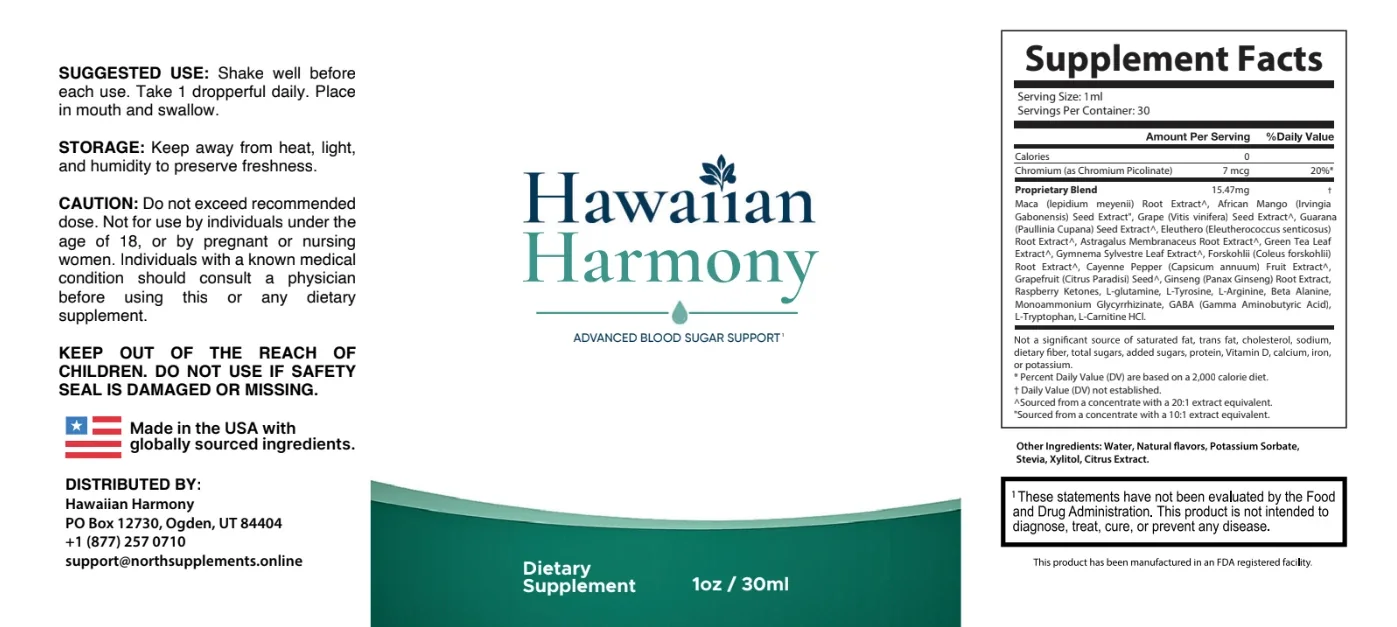
Where each name sits in the blend
Hawaiian Harmony's label prints its 15.47 mg Proprietary Blend as twenty-one names in descending order by weight, with no individual amount given for any of them. FDA's own labeling rule (21 CFR 101.36(c)) permits exactly this. What the rule does not permit is disorder: name six cannot outweigh name five. That single constraint is enough to calculate a ceiling for every position — the most that name could possibly weigh, if every name before it weighed the identical amount. Three of the twenty-one carry a specific reputation for stimulant or thermogenic activity in outside research, and none of the three sits anywhere near the top of the list.
| Name | Position | Concentrate | Ceiling here |
|---|---|---|---|
| Guarana Seed Extract | 4 of 21 | 20:1 | ≤ 3.87 mg |
| Green Tea Leaf Extract | 7 of 21 | 20:1 | ≤ 2.21 mg |
| Cayenne Pepper Fruit Extract | 10 of 21 | 20:1 | ≤ 1.55 mg |
Each ceiling comes from the same division used across the whole blend: 15.47 mg ÷ position number. Guarana sits fourth, so its ceiling is 15.47 ÷ 4. Green tea sits seventh, so its ceiling is 15.47 ÷ 7. Cayenne pepper sits tenth, so its ceiling is 15.47 ÷ 10. All three carry the label's ^ mark, meaning — per the footnote — each is sourced from a concentrate with a 20:1 extract equivalent.
A concentrate ratio says how much raw plant went into making the extract. It says nothing about what survived the process, and none of the three carries a standardisation percentage — no declared caffeine content for guarana, no declared EGCG content for green tea, no declared capsaicin content for cayenne. That gap matters for everything that follows.
Guarana: what 75 mg did in one placebo-controlled trial
Guarana (Paullinia cupana) is a seed, native to the Amazon basin, long used as a stimulant beverage ingredient before it became a supplement-label staple. A 2004 double-blind, placebo-controlled, counterbalanced study published in Pharmacology, Biochemistry and Behavior gave 28 healthy young adults (ages 18–24) single doses of 75 mg of a dried ethanolic guarana extract, 200 mg of Panax ginseng, the two combined, and a placebo, on separate days a week apart. Cognitive performance and mood were tested before dosing and again at one, 2.5, four and six hours afterward.
Relative to placebo, all three active treatments improved task performance across the day. Guarana specifically improved ‘attention’ task speed (with some evidence of reduced accuracy at the same time) and improved a sentence-verification task, and the guarana condition and the guarana–ginseng combination produced the largest improvements on a serial-subtraction task. The authors' own framing of the dose is worth quoting directly: at 75 mg of an extract carrying roughly 12% caffeine, the guarana dose supplied about 9 mg of caffeine — and the paper states the effects are unlikely to be attributable to its caffeine content
given how little caffeine that is. In other words, this was read as a guarana effect, not simply a caffeine effect.
Now the comparison. Hawaiian Harmony's guarana ceiling is 3.87 mg, at position four of twenty-one. Set against the 75 mg dose used in that trial, 3.87 mg is 5.16% of it. Read the 20:1 concentrate note in the label's favour — treat the whole 3.87 mg as concentrate and multiply back out — and the raw guarana seed behind it tops out at 77.4 mg. That is slightly more than the 75 mg used in the trial. But a concentrate is not interchangeable with the extract used in a study unless the two share a comparable caffeine percentage, and none is declared here. The comparison that can be made with the numbers actually on this label is the 5.16% figure: the guarana extract ceiling in this blend is one-twentieth of the extract dose in the one trial available.
Green tea: two trials, two different answers
Green tea's thermogenic reputation rests mainly on its combination of caffeine and catechins, chiefly epigallocatechin gallate (EGCG). A 1999 study in the American Journal of Clinical Nutrition put ten healthy men through three separate 24-hour stays in a respiratory chamber, dosing them at breakfast, lunch and dinner with either a green tea extract supplying 50 mg caffeine and 90 mg EGCG per dose, 50 mg of caffeine alone, or a placebo. Over the three doses, that is 150 mg of caffeine and 270 mg of EGCG across the day for the green tea extract condition. The green tea extract raised 24-hour energy expenditure by 4% and lowered the respiratory quotient significantly relative to placebo; caffeine alone, matched for the caffeine content of the extract, did neither. Urinary norepinephrine rose 40% on the green tea day. The authors' conclusion was explicit: the effect went beyond what the caffeine content alone could explain.
A later 2009 study, also in the American Journal of Clinical Nutrition, tested the same combination — green tea catechins plus caffeine — added on top of a high-protein diet during a weight-loss-maintenance period, and found no additional effect on weight regain compared with the high-protein diet alone. Put the two side by side and the honest summary is that green tea's catechin-plus-caffeine effect has shown up clearly in short, tightly controlled metabolic-chamber measurements and has not reliably shown up as an added benefit in a longer real-world maintenance setting, even at doses far above anything this label declares.
Hawaiian Harmony's green tea ceiling is 2.21 mg, at position seven. The 1999 trial's single dose was 90 mg of EGCG specifically, inside a 50 mg-caffeine extract dose. Comparing the whole 2.21 mg ceiling — not EGCG, the entire extract line — against that 90 mg EGCG figure gives 2.46%, and that is the generous comparison, because it treats every milligram of the 2.21 mg ceiling as if it were pure EGCG, which the label does not claim. No EGCG percentage is printed, so the true EGCG content of that 2.21 mg is unknown and could be far lower.
Cayenne pepper: what the review found, and what it takes to see it
A 2012 critical review and meta-analysis in Chemical Senses pooled the human trial literature on capsaicin (the pungent compound in chili peppers, cayenne included) and its non-pungent relative capsiate. The reviewers concluded that both compounds do increase energy expenditure and fat oxidation and do appear to reduce hunger sensations — especially at high doses
— but they were direct about the size of the effect: the magnitude of these effects is small,
and any practical benefit for weight management was described as modest at best.
Hawaiian Harmony's cayenne pepper fruit extract sits at position ten, with a ceiling of 1.55 mg of 20:1 concentrate and, again, no declared capsaicin content. The review's own framing already treats even the doses used in the studies it covers as producing a small effect; a milligram-scale ceiling with no standardisation percentage sits well below where that review says the effect becomes noticeable at all. This is one of the ten blend names for which this site's ingredients page could not find a single published daily amount to compare a ceiling against directly, because capsaicin content rather than crude extract weight is what the trials in that review actually dosed by — and this label does not print one.
Reading the three together
Add the three ceilings and the total is 7.63 mg — guarana's 3.87 mg, green tea's 2.21 mg and cayenne's 1.55 mg, stacked. That is under half of the entire 15.47 mg blend, and it is only mathematically possible because of the same descending-order rule that produced each individual ceiling: position four cannot outweigh the combined weight ahead of it, and position ten cannot outweigh position four. Nothing on the label says the three actually reach these ceilings simultaneously — they could be smaller, and the eighteen other names still have to fit inside whatever is left.
| Name | Ceiling | Study dose | Ceiling as % of study dose |
|---|---|---|---|
| Guarana Seed Extract | 3.87 mg | 75 mg extract (Kennedy 2004) | 5.16% |
| Green Tea Leaf Extract | 2.21 mg | 90 mg EGCG per dose (Dulloo 1999) | 2.46% |
| Cayenne Pepper Fruit Extract | 1.55 mg | No milligram ceiling published; review notes effects are dose-dependent and already “small” at the doses it covers (Ludy 2012) | not calculable |
What is missing: a caffeine line
Two of these three names — guarana and green tea — are recognised caffeine sources. Guarana seed is reported at roughly 3% to more than 5% caffeine by dry weight, well above the 1% to 2% typical of a coffee bean, a figure already cited on this site's ingredients page from a clinical monograph. Green tea's caffeine content varies by leaf grade and processing. Despite that, Hawaiian Harmony's Supplement Facts panel has no caffeine line at all — not for the finished serving, not for either ingredient individually. A buyer sensitive to caffeine, or told to avoid it, cannot check this label against that instruction, because the number the instruction refers to is not printed anywhere on it.
The bottom line
Guarana, green tea leaf extract and cayenne pepper fruit extract are named in Hawaiian Harmony's blend for reasons that show up in real, published human research — a cognitive-performance trial for guarana, a metabolic-chamber thermogenesis trial and a contradicting maintenance trial for green tea, and a critical review describing a small but real capsaicin effect. None of the three trials or reviews cited here was conducted on this product; each was conducted on a standardised extract or an isolated compound at a stated dose, in some cases many times heavier than what this label's own descending-order arithmetic allows for the corresponding name in this blend. Whether the amounts actually present behave the way the cited research behaves cannot be answered from what this label discloses, because the one number that would answer it — a standardisation percentage or a milligram-per-serving figure for caffeine, EGCG or capsaicin — is not printed.
Three questions this arithmetic tends to raise
Does a low ceiling mean these three names do nothing at all? Not necessarily, and this site does not claim that. Pharmacology is not always linear — some compounds show measurable effects at low doses and plateau or even reverse at high ones, and a trial run at 75 mg says only what happened at 75 mg, not what happens at 3.87 mg. What can be said honestly is narrower: the specific human evidence cited above was generated at doses this label's own arithmetic does not support being present at, so that evidence cannot be used to predict what this specific blend does. A smaller, untested amount might do something different, something smaller, or nothing measurable; nobody publishing on guarana, green tea or cayenne pepper has tested Hawaiian Harmony's actual ceiling amounts, so there is no trial to point to either way.
Why compare against the smallest published dose rather than an average or a typical commercial dose? Because it is the comparison most generous to the label. If Hawaiian Harmony's ceiling still falls to a low single-digit percentage of the smallest dose that has shown an effect in the literature, it necessarily falls to an even smaller percentage of every larger dose in that same literature. This is the same convention used throughout this site's ingredients page, applied consistently rather than picked to make any one ingredient look better or worse than another.
Why doesn't the label simply print a caffeine total, if two of the three names are caffeine sources? Nothing supplied with this product explains that omission, and this site will not guess at a reason it cannot verify. What can be said is that a caffeine line is not a required field on a Supplement Facts panel the way total calories or a nutrient with an established Daily Value is; a manufacturer can choose to add one voluntarily, and this one has not. The result is a real information gap for anyone managing caffeine intake for a medical reason, a pregnancy, or simple personal sensitivity — a gap this label leaves for the buyer to notice rather than close.
Sources
- Improved cognitive performance in human volunteers following administration of guarana (Paullinia cupana) extract: comparison and interaction with Panax ginsengKennedy DO, Haskell CF, Wesnes KA, Scholey AB. Pharmacol Biochem Behav. 2004;79(3):401-11. PMID 15582012Single 75 mg dose of guarana extract (≈12% caffeine, ≈9 mg caffeine) improved attention-task speed and serial-subtraction performance versus placebo in 28 healthy adults; authors state the effect is unlikely to be attributable to caffeine content alone.
- Efficacy of a green tea extract rich in catechin polyphenols and caffeine in increasing 24-h energy expenditure and fat oxidation in humansDulloo AG, Duret C, Rohrer D, et al. Am J Clin Nutr. 1999;70(6):1040-5. PMID 10584049Doses of 50 mg caffeine + 90 mg EGCG given three times daily raised 24-h energy expenditure 4% versus placebo; caffeine alone at a matched dose had no effect.
- Green tea catechin plus caffeine supplementation to a high-protein diet has no additional effect on body weight maintenance after weight lossHursel R, Westerterp-Plantenga MS. Am J Clin Nutr. 2009;89(3):822-30. PMID 19176733The same catechin-plus-caffeine combination added no additional weight-maintenance benefit on top of a high-protein diet.
- The effects of capsaicin and capsiate on energy balance: critical review and meta-analyses of studies in humansLudy MJ, Moore GE, Mattes RD. Chem Senses. 2012;37(2):103-21. PMID 22038945Capsaicin and capsiate both increase energy expenditure and fat oxidation and reduce hunger, especially at high doses; the magnitude of the effect across the pooled literature is described as small.
- Guarana — clinical monographDrugs.com natural products databaseGuarana seed is reported at roughly 3% to more than 5% caffeine by dry weight, against about 1% to 2% for coffee beans. Already cited on this site's ingredients page.
- Dietary Supplement Labeling Guide, Chapter IV: Nutrition LabelingU.S. Food and Drug AdministrationBlend ingredients must be listed in descending order of predominance by weight, with the blend's total weight declared. 21 CFR 101.36(b)(2) and (c).